Friday, October 28, 2016

Postcard from Japan: Sunday, October 23, 2016

Today we visit the horses!  Tomoko-san owns two horses that she rides each weekend at a horse-back riding club.   She lives in Ashiya-shi which is a fairly large city near the coast (now famous, my mother-in-law tells me, for its millionaires).   The club and stables are about a 2-hour drive north into the mountains.

Tomoko's yellow speed demon.
My friend has a yellow car and drives really fast.  The speed limit on the highway is 80 kilometers per hour.  At one point she was driving 140.... It wasn't scary since she's a good driver and doesn't zoom back and forth from lane to lane, but I asked her about the speed limit.  She said that if she sees a police car (I haven't seen one once and I've been in a lot of cars this trip), she goes back down to 80.

In doing the conversion from kilometers to miles/hour, one mile equals .62137 kilometers, so 80 is just over 49 mph.  No wonder she wants to go faster (and so was everyone else).

We stop at a rest stop to buy lunch since the club doesn't have any food or beverages available on site.  Packaged ready-to-eat food is called Obento.  Long ago when I was a student (1971-72), at train stops, we'd jump out onto the station platform and buy an Obento that was packaged in a ceramic bowl with a wood lid.  Now with the age of plastic, it has a see-through lid and there are many to choose from, mostly hot and ready to eat.

We can also see Lake Biwa from the scenic overview.  Biwa-ko is the largest lake in Japan and sits in between the mountain range we often call the Japanese Alps.

Tomoko-san's horses are cared for during the week by the club's grooms, some very nice sweet-natured men who I get to meet.  The club is very busy today as it's Sunday.  There are about 50 or so horses stabled here.  The area includes a club house (where I sit while catching up on typing blog posts), the stable of horses, the building where the horses are washed and brushed down, a small storage area in which people keep their gear and take showers, and the practice riding area.

Lollipop is Tomoko-san's oldest horse at 27 years old.  Purple Cobra is the youngest at 15.

The horse, Lollipop.
The horse, Purple Cobra.
Iseto is the name of the dessert shop.  For those of you in
the Michigan League of Handweavers, I used my
conference bag from 2015 as my carry-on all purse bag
and it has proved to be the perfect bag!  So here's
MLH in Japan!
Tomoko-san is practicing for a riding competition so, after washing and brushing each horse, she spends time riding each one, especially practicing for the competition on Purple Cobra.  The big event of the day for the horses is getting to eat carrots!  When I first arrived at her house and we went out grocery shopping, we stopped at her local little vegetable store where the owner brought out a big bag of carrots she had ordered.  (She says she doesn't tell him they're for horses....)  Japanese carrots are short and wide compared to America's long thin carrots.  I don't think her two horses would care as they gobble them up. The neighboring horses are pawing the ground with their hooves, asking for carrots, too.  Fortunately there are some left over and Tomoko-san goes around giving everyone a carrot.

Traditional Japanese Okashi molds
So the horses get carrots and we get to go for dessert.  Tomoko-san has been treating me daily to wonderful lunches and dinners, all out at restaurants, since I get the feeling she does not cook.  (Also, she knows all the restaurants, especially the really excellent ones, so I assume she regularly eats out.) I told her I want to treat her to dessert at a dessert coffee shop.  I am very fortunate that she loves desserts just as much as I do, although it doesn't show on her as it does on me.  She's my height (and age) but very thin.

She already knows an excellent shop.  After we finish thoroughly enjoying cake and coffee (for her) and tea, I realize that I didn't take a picture.  We laugh at the fact that eating it was so much more important than showing anyone how gorgeous it looked.

As we leave, there's a huge display of wood carved molds.  Obviously, since it's a dessert shop they're for some kind of sweets probably the traditional Japanese Okashi, but neither Tomoko-san or my mother-in-law know exactly what they are.  But the delicacy of the carving and the detail is extraordinary.

Tomoko-san decides to take the slow route home and avoid some of the highway tolls.  So we get to see an beautiful sunset and the car lights of the highway.

Wednesday, October 26, 2016

Postcard from Japan: Saturday, October 22, 2016, Part Two


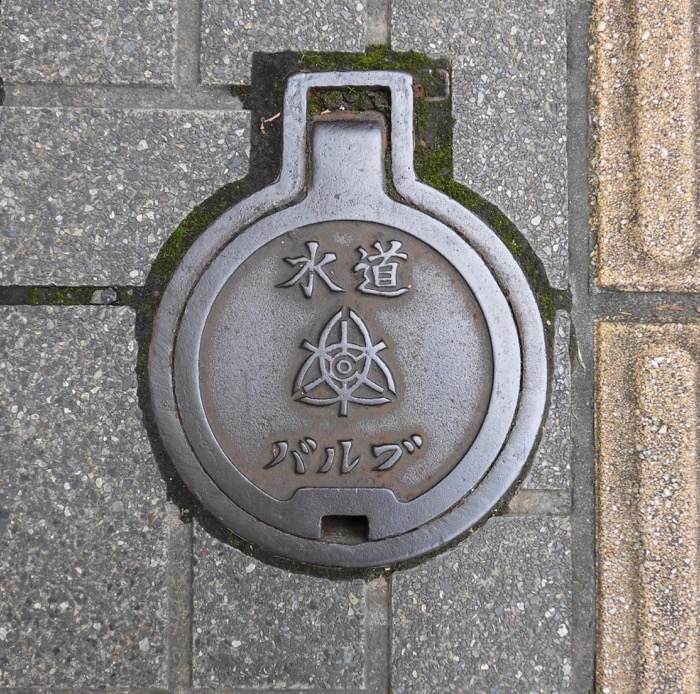
This short post will be about the lovely manhole covers in the city of Himeji.  The theme is the crane since Himeji means "white heron."

This is possibly for firefighters' access to water as the 2nd
character in the left group mean fire.


A small one the says "Water Road" on top and "barubu" on the
bottom.....

Postcard from Japan: Saturday, October 22, 2016, Part One

Himeji Castle looms over the city with the main thoroughfare
directly in front.  An amazing sight as you leave the train station
to walk to the castle grounds.

Today, Tomoko-san and I go to Himeji Castle in Himeji city.  I am glad that I didn't realize ahead of time how difficult the steep slope entrance and the stairs/stairways inside would be to climb.  Himeji Jo (castle) is famous for its military strategy in defensive walls, entrances and armament positions.

The steep slope is very difficult to walk up (small stones with large stones at the edges), circuitous twisting paths (no straight line entrances), and always moving up.  From the castle, the samurai warriors were able to see all the entrances below so no surprise enemy attacks.  (No attacks were ever experienced so they don't know if the defenses worked or not.)  And, of course, my camera had died so I couldn't take any pictures.

At some point, we all (this is Saturday so there were a lot of tourists) had to remove our shoes and carry them in a plastic bag.  The very top level is the 7th floor.  Tomoko-san and I (and everyone else I guess) climbed to the top.  I wondered if it was like climbing to the top of the Washington Monument, and back down.
Map of the castle grounds with the samurai families
living within the dark blue walls of the inner city
and the merchants and townspeople living on the
outer edge.

Close-up detail of inner castle area.
Of course, we took time to have lunch before the big climb--- sushi!
Tomoko-san at the sushi-ya.


Japan is experiencing a tourist boom all year long and so many signs are also in Chinese, Korean as well as Japanese and English.  Fortunately, the train and subway station signs are now always in English (Roman letters) as well as Chinese characters, which Japanese uses, along with the two phonetic alphabets of hiragana and katakana.  For those staying in Japan for more than a vacation, learning the basic phonetic alphabets helps tremendously to read signs and directions.

Because my camera had died and I was determined to get a new one, Tomoko-san was kind enough to take me to a big techy store with cameras.  I'm just beginning to appreciate my new camera.  It's turquoise!

Postcard from Japan: Friday, October 21, 2016

My favorite beverage:  Japanese green tea
Caroline picked me up at 5:30 this morning so she can take me to the bus station.  With more little omiyage from her for Mama-san, Forde, and me, my bags are stuffed and heavy.  But declining an omiyage is rude and no fun.  She’s bought a green tea latte for me and peanut tofu. Unfortunately, I do have to give the hot container of tea back to her as there is no cup holder in the bus and in my sleepy condition I’m sure I’d spill it all over me.  I have 4 hours to wait for my flight so I eat the peanut tofu later at the airport --- a lovely subtle flavor.


It’s difficult to say goodbye to Caroline as we’ve only had a little over a day to visit after all these years. (We haven't seen each other in about 35 years or so.)  And she's been so generous in her time, driving and spirit.  She seems to know everyone.  Fortunately there is email!  Caroline has to leave by 6:00a.m. in order to get to her class at 9:00a.m.  It's not that far but evidently the traffic is so bad that it takes 2-3 hours instead of the 1 hour it should take so once she drops me at the bus depot, it's a quick but emotional hug and she's on her way.

The flight from Naha to Kobe is just as nice and smooth as the longer one from Tokyo but this time I get a window seat overlooking the ocean, not the land.

It's so wonderful to finally see my friend, Tomoko Miura, at the Kobe Airport arrivals area!  Like Caroline, it's been a long long time since we've seen each other (11 years or so).  Tomoko was a student on a summer language program to my alma mater, Hope College, in Holland, Michigan, from Hope's sister college in Tokyo, Meiji Gakuin,  in 1973.  (Tomoko went to Tada University in Tokyo as a International Relations major.  Her English is fluent.  She also speaks Hungarian, a sister language of Japanese as is Finnish.)  I was supposedly teaching English as a Second Language for that summer program--- questionable as I didn't feel I was very good at it but I think they thought that since I had just returned from being a foreign student in Japan the previous year, I was qualified.  Hmmm.   Tomoko and I are both so glad we've kept in touch all these years.  (She visited my former husband, Richard, and I in the late 80's at New Years so she could go to New York City's Time Square and see the Ball drop.  She was meeting a friend there.)

There are no pictures remaining from my arrival at Kobe and the scenes from the industrial port there because my camera was definitely dying....  Unfortunate as the pictures were of the huge orange and white cranes that unloaded cargo from the ships.  Kobe is a major port for Japan.

We took the train from the airport into Kobe and then the train to her town of Ashiya to the west in Hyogo-ken (prefecture).  Always fascinating views from the trains.  I love to constantly watch the houses and the big huge buildings that these cities produce.

When we finally reach Ashiya-shi (Ashiya-city), Tomoko-san explains that when her parents purchased their house, the area was very middle-class with moderate incomes.  In the last years, it's become a very fashionable and expensive area in which to live.  There are expensive (and excellent) restaurants, high end clothing stores, and very unusual and beautiful houses.  
Very unusual and expensive house front (garage to
left and front door at end on right).  Flower planters
are in the middle alcoves.  Traditional American
quilt pattern mosaics are part of the sidewalks.
They also have some exceedingly beautiful manhole covers!  Each city has it's special identifying theme.  In Ashiya, it's Japanese pine tree (matsu) and waves.  I kept stopping and taking pictures!
Ashiya city manhole cover with Japanese matsu
pine trees and waves

Manhole cover with lilies for water drainage
Manhole cover for electricity
Very small "manhole" cover for water connection

After settling at her house (very, very steep and long stone stairs up to her front door) and more stairs up to my room (these stairs will become an inside joke between us--- more soon on this).  She loves cats, as I do, but hers are extremely shy.  I'm not quite sure how many she has---- 5 or 7, I think.  All are rescued from outside.  It's only within the last day or so that I have been able to somewhat pet and scratch Bibi---somewhat.
Steep driveways and steep stairs
are everywhere.

Bibi

Steep stairs to Miura's house.


Sunday, October 23, 2016

Postcard from Japan: Thursday, October 20, 2016

Woven banana fibers (ito bashofu) with kasuri (ikat) sections
dyed in indigo.


This is the day that Caroline and I spend traveling all over northern Okinawa and the small islands nearby that are connected by bridges.  My camera is only working on rare occasions....
Ito bashofu (fiber banana) used for creating woven banana fabric.

The first weaving center we go to features cotton fabric that's woven with a combination of kasuri designs (ikat), usually dyed in indigo, and small overshot patterns of a different color than the main cloth.  We aren't allowed to take any pictures.

Hana bashofu (flowering banana plants)
We then go to a weaving studio that is famous because of it's use of banana fibers.  Most of us wouldn't realize that there are three different types of banana plants.  We know of the fruiting banana trees that produce all the yellow bananas we get in the grocery store.  (For those visiting Meijer Gardens in Grand Rapids, Michigan, you can see fruiting banana trees in the Conservatory.)   But there is also the flowering banana (the Chinese one shown here has red flowers and is only about 6' tall).  Then there is the fiber banana, here in Okinawa called ito bashofu (ito means thread).  These plants grow much taller, maybe 8'-10' tall..

Toshiko Taira is credited with the revival of this ancient Okinawan technique.  Taira-sensei (sensei means teacher) is now 97 years old and a Living National Treasure of Japan having been presented with the tribute by the Emperor this year.  (A link to her tribute with excellent images: https://travel67.com/.../toshiko-taira-japanese-living-na...)  Her village of Ogimi is the only place remaining where this type of weaving is still produced.  The entire process, from harvesting the stalks to the final woven fabric, takes months.

First we watched a short documentary about the entire process and then went upstairs to view the studio where students of Taira-sensei weave the final cloth.  Taira-sensei sits off to the side joining the individual lengths of banana fibers with a weaver's knot.

A tiny, very sweet and generous woman, she came all the way downstairs (she broke her hip last year but then was climbing up and down the stairs after a very quick recovery) to show us the tribute book from the Emperor with her photograph and those of her family (one of her children is married to an American and her grandchildren attended the ceremony also).  She also answered questions about the technique and then gave Caroline and I a booklet explaining the technique with sample fibers and fabric included.  (Caroline took pictures of Taira-sensei and I since my camera wasn't working--- hopefully to be added soon.)

Upstairs near the studio are the indigo vats she uses to to dye the bound and resisted banana threads for kasuri.  A pattern is first designed and measured, and then bound with plastic strips in sections.  
Ceramic vats containing indigo for dyeing the banana fibers.
A weaving with some abstract portions. (The glare from the glass
and lights unfortunately distorts part of the image.)


A $500 purse (about 15" long) from banana fibers.

Banana fibers produce a somewhat stiff and smooth surface.  The very inner fibers are used for kimono fabric, the middle fibers for obi and table runners, and the outer stiffest fibers are used for anything needing a very stiff fabric.  

What a thoroughly exciting and enjoyable visit!  (I later asked Caroline to choose some of my handprinted coasters to send to Taira-sensei as a thank you for all the time she took to talk with us.)